

Ask five London agencies to quote for the same website, and you’ll get five very different numbers. One says £2,500. Another says £18,000. A third won’t give you a price until after a “discovery workshop”. And when you Google “best web development company in London”, most of the lists you find were written by an agency that, surprise, ranked itself number one.
Table of Contents
- Quick picks: the best website development company in London for your business
- How we chose these London web development companies
- 11 London web development companies at a glance
- The 11 best website development companies in London (2026)
- How much does a website development company in London charge?
- Shopify vs WooCommerce vs WordPress vs custom: pick the platform first
- What a good London web developer should handle for you
- Redesign or rebuild? Fixing a site with low traffic or low sales
- UK legal checklist for your new website
- 10 questions to ask before you hire (and the red flags)
- Agency, freelancer or DIY: which is right for you?
- Frequently asked questions
- Final thoughts
Full disclosure up front: this guide is published by Stacksole, a London-registered web development and digital marketing agency, and we’ve put ourselves first. Every other agency is profiled with exactly the same template, including our own downsides, so you can judge for yourself. We went through each company’s own site, its published prices, named clients and review profiles, and noted which platforms it actually builds on. Then we matched each one to the kind of business it suits best, from a Shopify beauty brand to a dental clinic in Ealing.
TL;DR
- Want build, SEO and Google Ads from one team at a lower cost? Stacksole (our own agency) is UK-registered with an in-house development team in Mumbai.
- Running a Shopify store? Start with We Make Websites or Charle.
- Small business on a budget? DCP Web Designers builds WordPress sites at prices local businesses can live with.
- Startup that needs flexibility? Shoreditch Design offers fixed-price, day-rate and retainer options.
- Prefer a platform specialist with SEO? Charle (for Shopify stores) and DCP (for WordPress sites) both offer SEO alongside the build.
- Typical London budget: £3,000–£8,000 for a small business site, £5,000–£30,000 for a proper e-commerce build, plus 20% VAT.
Last verified: October 2026. No other agency paid to be included.
Quick picks: the best website development company in London for your business
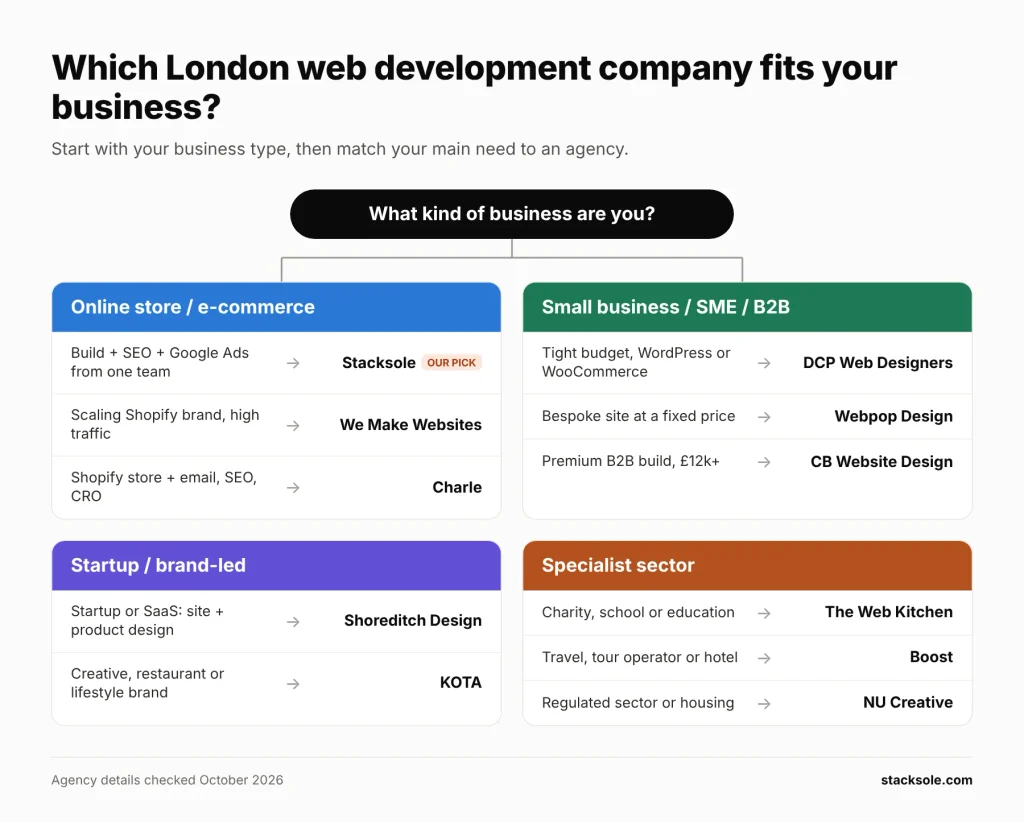
Short on time? Find your business type below and start there. Every pick is explained in detail further down.
| If you are… | Start with | Why | Published starting price |
|---|---|---|---|
| A store owner, D2C brand or small business wanting build + SEO + Google Ads from one team | Stacksole (our agency) | UK company with an in-house dev team in Mumbai; Shopify, WooCommerce, WordPress and custom builds | Free quote |
| A Shopify brand doing serious volume (fashion, beauty, D2C) | We Make Websites | Shopify partner since 2011; clients include Good American and Jigsaw | On request |
| A growing Shopify store that also needs marketing | Charle | Shopify Plus accredited, plus SEO, email and CRO in-house | On request |
| A small business, local shop or WooCommerce store on a budget | DCP Web Designers | Fixed-price WordPress and WooCommerce builds, 3–6 week turnaround | £1,495 + VAT (brochure), £1,995 + VAT (WooCommerce) |
| A startup or SaaS founder | Shoreditch Design | Product design and web in one studio; works with early-stage tech | On request |
| An SME needing a bespoke WordPress site | Webpop Design | Fixed-price proposals, milestone payments, 30 days free support | £8,000 |
| A B2B company or established brand wanting a premium build | CB Website Design | Projects average £20k–£25k; you own everything on final payment | £12,000 |
| A creative, consumer or hospitality brand | KOTA | Strong design, published results such as an 83% sales lift for Wogan Coffee | On request |
| A charity, school or education provider | The Web Kitchen | Webby-winning school site; Farm Africa donations up 21% | On request |
| A travel, tourism or hotel business | Boost | Certified Webflow partner focused purely on travel | On request |
| A regulated, housing or purpose-led organisation | NU Creative | B Corp certified, decades of regulated-sector work | On request |
“On request” means the agency doesn’t publish prices. That’s normal in London, but it’s also why you should get at least three quotes for the same brief.
How we chose these London web development companies
We started with around 25 agencies that show up repeatedly in London searches and agency directories, then cut the list using six questions:
- Do they actually build, not just design? Some “web agencies” hand development to freelancers. We favoured teams that list development platforms and in-house build work.
- Is there a real UK presence? Several agencies on other lists are based abroad with no UK company behind them. Every pick here has a London address, and where development happens elsewhere, we say so.
- Can you see the work? Named clients and live case studies beat logo walls. Where an agency publishes results, we note them, and we say so when the figure is self-reported.
- What do reviewers say? We looked at Google, Clutch and Trustpilot counts, not just star averages. Forty 5-star reviews tell you more than four.
- Are prices transparent? Agencies that publish a starting price or payment structure scored higher, because it saves you a wasted discovery call.
- Who are they best for? No agency is right for everyone, so each pick is matched to a type of business rather than ranked purely on size.
No other agency paid to be listed. Stacksole, at number one, is our own agency; we’ve held it to the same template, weaknesses included.
Editor’s note before publishing: add each company’s Companies House status and a mobile PageSpeed Insights score (agency site + one client site) with the test date. These are the two data points no competing list includes.
11 London web development companies at a glance
| Agency | London base | Main platforms | Best for | Typical timeline | Published reviews |
|---|---|---|---|---|---|
| Stacksole (our agency) | East Ham, E6 (registered office) + Mumbai dev centre | WordPress, WooCommerce, Shopify, Magento, Webflow, custom | Stores and SMEs wanting build + marketing | From 5–6 days (standard site) | Testimonials on site |
| We Make Websites | Pentonville Rd, N1 | Shopify, Shopify Plus, headless | Scaling Shopify brands | On request | Not published on site |
| Charle | London | Shopify, Shopify Plus | Shopify brands wanting build + marketing | On request | Not published on site |
| DCP Web Designers | W1 + Ilford, IG1 | WordPress, WooCommerce | Small businesses, local services | 3–6 weeks | 400+ Google (4.9), 40 Clutch (5.0) |
| Shoreditch Design | Luke St, Shoreditch | Webflow, custom | Startups, SaaS, tech | On request | 70+ Google, 20+ Trustpilot |
| Webpop Design | Primrose Hill, NW1 | WordPress, WooCommerce, Shopify | SMEs, redesigns | 10–12 weeks | 20 Google (5.0) |
| CB Website Design | New Cavendish St, W1 | WordPress, custom front ends | B2B, established brands | 6–8 weeks (brochure), 12+ (store) | 50+ reviews (5.0) |
| KOTA | Clerkenwell, EC1 | WordPress | Creative and consumer brands | 12–14 weeks | Clutch 2024 Global Winner |
| The Web Kitchen | Holborn, EC1 | WordPress, headless | Charities, schools, education | On request | Not published on site |
| Boost | London | Webflow | Travel and hospitality | Audit first, then quote | Not published on site |
| NU Creative | Marsh Wall, E14 | Custom web builds | Regulated sectors, housing, B Corps | On request | Not published on site |
Review counts are as shown on each agency’s own website in October 2026. Check the live profiles before you decide, because numbers change fast.
The 11 best website development companies in London (2026)
1. Stacksole — best for stores and small businesses that want build and marketing at a lower cost
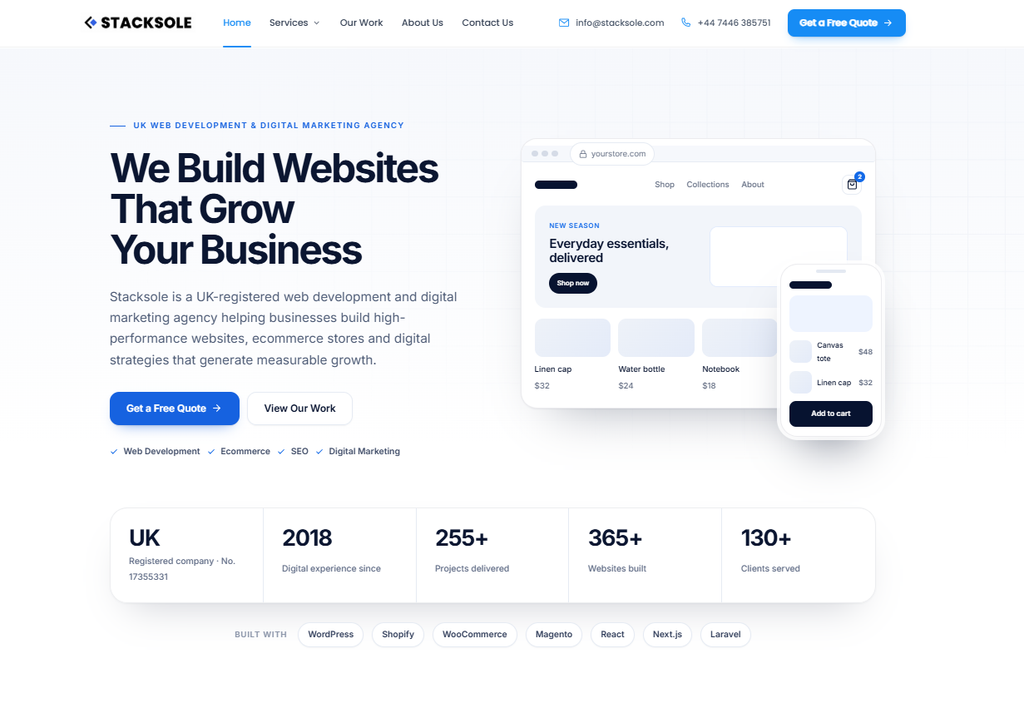
Stacksole is the trading name of NEPTISE LTD, a UK-registered company (No. 17355331) with its registered office in East Ham, London E6, and its development centre in Mumbai. That setup is the whole point: you sign with a UK company and get a UK phone number, while an in-house team in India does the build. The result is London-standard work without London day rates.
The platform range is wide: WordPress, WooCommerce, Shopify, Magento and Webflow, plus React, Next.js, Laravel and Node.js for custom builds. Unlike pure build studios, the same team runs SEO, Google Ads and Social media marketing, so the people who build your store can also drive traffic to it. Stacksole reports 255+ projects for 130+ clients, with portfolio work in beauty and cosmetics, fashion, jewellery and pet care, and industry sites for healthcare, real estate, education and legal firms. A standard website can launch in five to six days.
Choose them if you run a Shopify or WooCommerce store, a D2C brand or a small business, and you want one team for the website, SEO and Google Ads at a price that fits.
Think twice if you want regular in-person workshops at a London studio. Development and most meetings are remote. Prices aren’t published either, so ask for a free quote.
2. We Make Websites — best for Shopify brands ready to scale
We Make Websites has been a Shopify partner since 2011, which makes it one of the longest-standing Shopify specialists in the UK. Its studio is on Pentonville Road, with a second office in New York.
The client list is the giveaway: Good American, Jigsaw, Toteme, OPI and UFC. These are brands with big catalogues, international shipping and serious traffic spikes. The team handles design, Shopify development, data migration, internationalisation and headless builds.
Choose them if you already sell through Shopify (or are outgrowing WooCommerce) and need a store that holds up when a TikTok post sends 20,000 people to your product page at once.
Think twice if you’re a new dropshipping store. Prices aren’t published, and a team used to global fashion brands won’t be the cheap option.
3. Charle — best for Shopify stores that want build and marketing in one place
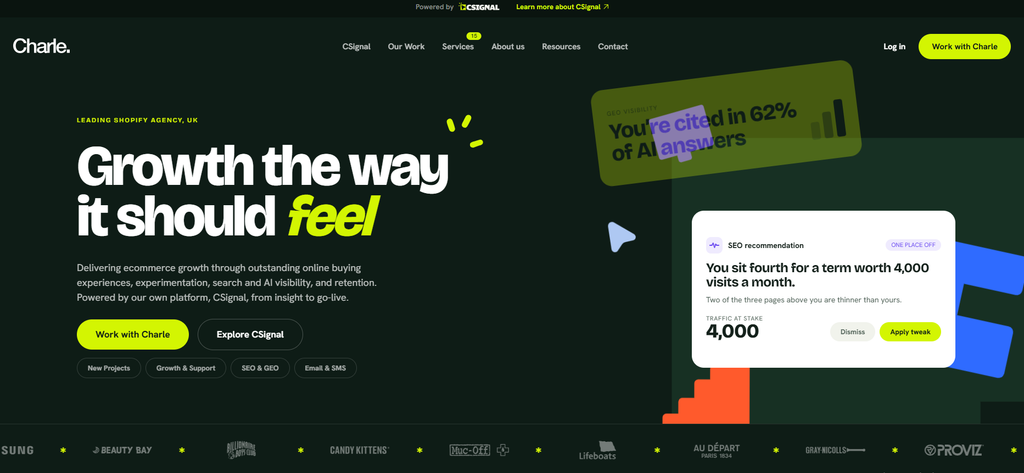
Charle holds Shopify Plus accreditation and works from London. What sets it apart from pure build agencies is the marketing side: SEO, generative engine optimization (GEO), email and SMS, conversion rate optimization and ongoing support retainers.
Its clients include Cambridge Satchel, 111SKIN, Candy Kittens, Vollebak and the RNLI. That’s a useful spread: a heritage fashion brand, a skincare label, a confectionery D2C brand and a charity shop.
Choose them if you’re a fashion, beauty or D2C brand and you’d rather not juggle one agency for the build and another for email and SEO.
Think twice if you only need a one-off build with no ongoing work. You’d be paying for marketing depth you won’t use.
4. DCP Web Designers — best for small businesses on a budget
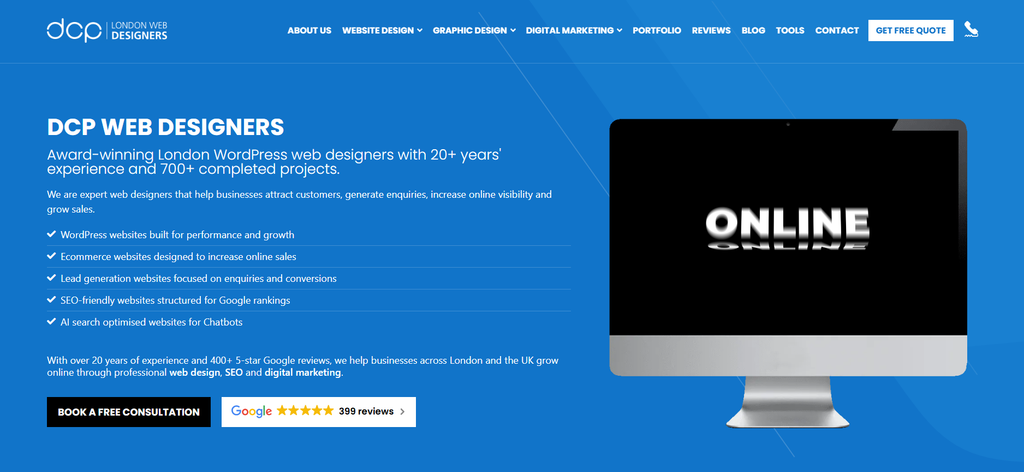
DCP is the rare London agency that publishes its prices: brochure sites from £1,495 + VAT and WooCommerce stores from £1,995 + VAT. Most projects take three to six weeks.
It’s been running since 2004, has completed 700+ projects, and shows 400+ Google reviews averaging 4.9, plus a 5.0 rating from 40 reviews on Clutch. Builds use WordPress, WooCommerce and Elementor Pro, with Cloudflare and NitroPack for speed. Clients get training so they can update the site themselves, and monthly SEO support is optional.
Choose them if you run a local service business, a restaurant, a salon or a first online shop and want a working, editable site without a five-figure bill.
Think twice if you need heavy custom functionality. A starting price is a starting price; complex integrations will add to it.
5. Shoreditch Design — best for startups and SaaS founders

Shoreditch Design works from Luke Street in Shoreditch, with studios in Los Angeles and Melbourne. It covers branding, UI/UX, digital product design and web development, so a founder can get the marketing site and the app interface designed by the same team.
Named clients are largely tech: Ophelos, Oddsjam, Maihem, Polaron and Played. The site shows 70+ five-star Google reviews and 20+ on Trustpilot. Rates are agreed on an intro call, and retainers are available, which suits startups that ship in sprints.
Choose them if you’re pre- or post-seed and need a site that looks credible to investors and converts sign-ups.
Think twice if you’re a traditional retailer. Their sweet spot is tech, not product catalogues.
6. Webpop Design — best for SMEs that want a fixed price
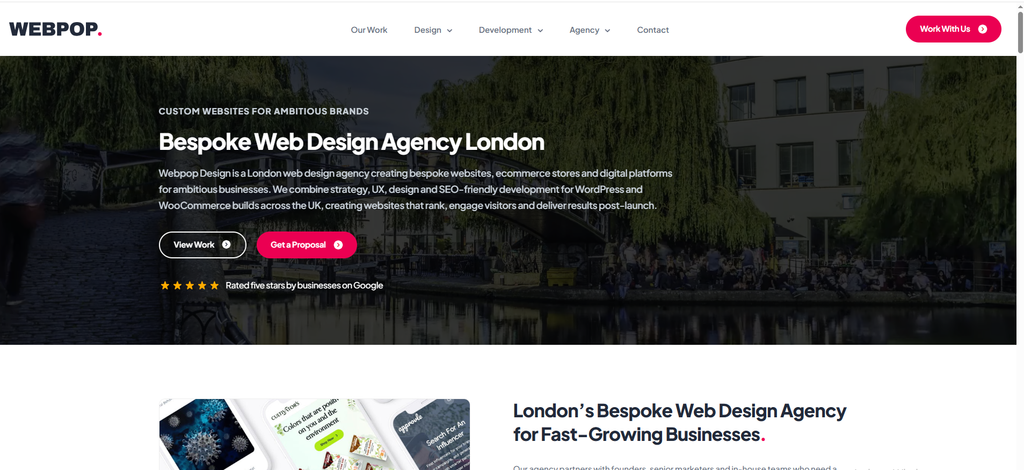
Webpop Design, based in Primrose Hill, builds bespoke WordPress and WooCommerce sites, plus some Shopify work. Projects start from £8,000, every quote is a fixed-price proposal, and payments are split across milestones. Each launch includes 30 days of free support, with care plans after that.
One client, Allegiant Finance, reports a 35% increase in conversions after launch. Typical projects run 10 to 12 weeks.
Choose them if you’re an SME or B2B firm replacing a dated site and you want the cost locked in before work starts.
Think twice if you need to launch in a month. Ten weeks is realistic for bespoke work, not fast.
7. CB Website Design — best for B2B and established brands
CB Website Design’s studio is on New Cavendish Street. It’s unusually open about money: projects start at £12,000 and average £20,000–£25,000, paid 50% upfront, 35% before build and 15% before launch. Ownership transfers on final payment, with no compulsory monthly fees.
Projects include the NATO Innovation Fund and Recharge.com. Brochure sites take about six to eight weeks, stores twelve or more. Every project includes 30 days of fixes and three months of search and AI-visibility reporting.
Choose them if you’re a B2B company, consultancy or funded business where the website has to impress procurement teams.
Think twice if your budget is under £10k.
8. KOTA — best for creative and consumer brands
KOTA has been designing and building websites from Clerkenwell since 2013. It was a Clutch 2024 Global Winner and holds a 2025 Great Place to Work certification. Clients have included Jamie Oliver, Penguin, Penhaligon’s and Comptoir Libanais.
It publishes results from its own case studies: Wogan Coffee’s sales rose 83% within a year, and ISI Global’s organic visits more than doubled in a month. Builds run 12 to 14 weeks on WordPress, with SiteCare support afterwards.
Choose them if your brand lives or dies on how it looks, such as a restaurant group, a fragrance house or a lifestyle label.
Think twice if you need Shopify. KOTA’s published work is WordPress-based.
9. The Web Kitchen — best for charities and education
The Web Kitchen, in Holborn, builds every site on a customised WordPress setup and offers headless and enterprise WordPress for bigger projects. It has 28 staff and offices in London, New York and Brighton.
Two results stand out. Its Wellington College site was named the best school or university website in the world at the 2023 Webby Awards. And Farm Africa’s donations rose 21% after its redesign. The agency also reports over a million school meals donated and 70,000+ trees planted.
Choose them if you run a charity, school, membership body or purpose-led organisation.
Think twice if you’re an online store. Their strengths are content and fundraising, not checkouts.
10. Boost — best for travel and hospitality businesses
Boost is a certified Webflow partner that works only with travel brands: tour operators, destinations, hotels and lodges. Founded in 2019, its clients include Ker & Downey Safaris, Africa Born and ROAM.
It won’t quote blind. The founder audits your current site first, then prices the work, which avoids paying for a rebuild you don’t need.
Choose them if you run a hotel, tour company or travel brand and want a site your team can edit easily in Webflow.
Think twice if you’re outside travel. Boost is deliberately narrow.
11. NU Creative — best for regulated and purpose-led organisations
NU Creative, based at Marsh Wall in Canary Wharf, is a certified B Corp that has spent more than twenty years working with businesses in highly regulated industries. It also builds with sustainability in mind, aiming to lower the carbon footprint of its websites.
Clients include the London Borough of Enfield, Dexory, Crawford & Company and the Social Mobility Foundation. It also designs bid and tender materials, useful for B2B firms that win work through procurement.
Choose them if you’re in housing, healthcare, financial services or another regulated sector where the message must be clear and compliant.
Think twice if you need e-commerce. Their focus is brand and lead generation.
How much does a website development company in London charge?
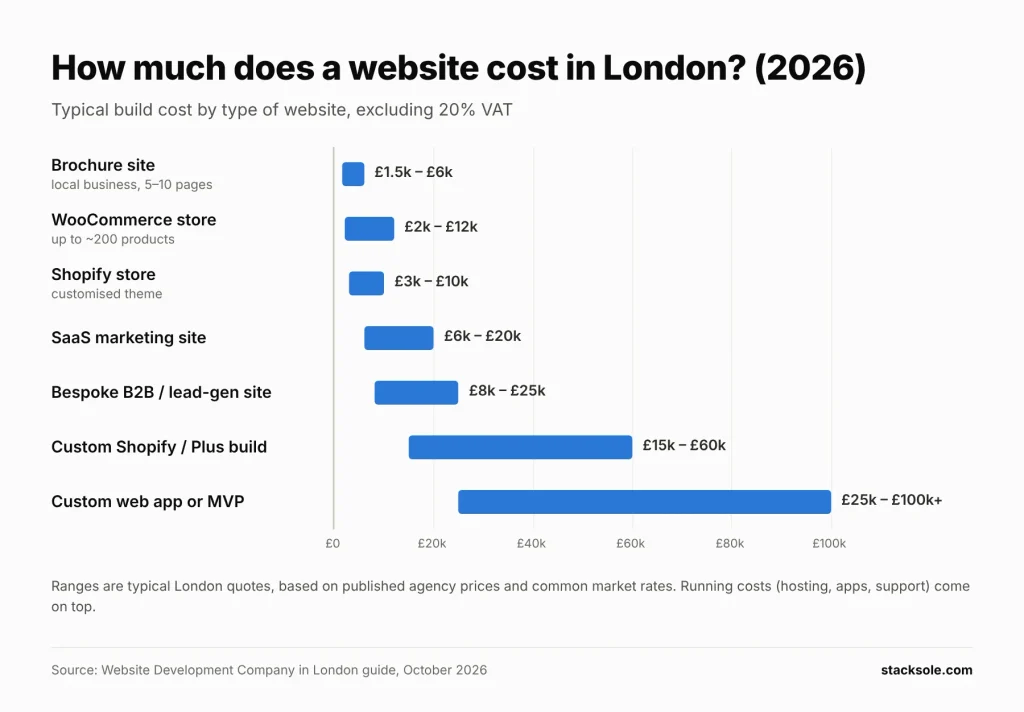
Most London small-business sites land between £3,000 and £8,000, and most proper e-commerce builds between £5,000 and £30,000. Add 20% VAT if the agency is VAT-registered, which almost every agency on this list is. A lot of comparison articles leave VAT out, and it’s an unwelcome surprise on a £15,000 invoice.
| Type of website | Typical London build cost (ex. VAT) | Incl. 20% VAT | Typical timeline |
|---|---|---|---|
| Brochure site for a local business (5–10 pages) | £1,500–£6,000 | £1,800–£7,200 | 3–8 weeks |
| WooCommerce store (up to ~200 products) | £2,000–£12,000 | £2,400–£14,400 | 4–10 weeks |
| Shopify store on a customised theme | £3,000–£10,000 | £3,600–£12,000 | 4–8 weeks |
| Custom Shopify / Shopify Plus build | £15,000–£60,000+ | £18,000–£72,000+ | 10–16 weeks |
| Bespoke B2B or lead-generation site | £8,000–£25,000 | £9,600–£30,000 | 8–14 weeks |
| SaaS marketing site | £6,000–£20,000 | £7,200–£24,000 | 6–12 weeks |
| Custom web app or MVP | £25,000–£100,000+ | £30,000–£120,000+ | 3–6 months |
These ranges are built from the published prices above (DCP from £1,495, Webpop from £8,000, CB averaging £20k–£25k) and the quotes typically seen in London. Treat them as a sense check, not a price list.
London vs the rest of the UK vs offshore
London agencies cost more because London salaries and rents cost more, not because the code is better. Rough day rates look like this:
| Where the team is | Rough day rate | When it makes sense |
|---|---|---|
| London agency | £500–£1,000+ | You want in-person workshops, a regulated sector, or a brand-led build |
| Regional UK agency (Manchester, Bristol, Leeds) | £350–£700 | Same time zone and contracts, lower overheads |
| Eastern Europe nearshore | £250–£450 | Strong engineering for custom builds, slight time difference |
| India or South-East Asia offshore | £100–£300 | Clear specs, standard platforms, someone on your side managing quality |
A practical middle path many small brands use: a London or UK agency for strategy, design and project management, with development handled by a vetted offshore partner. Just ask about it up front, so you know who is writing your code.
The real cost: 3 years of ownership
The build is only the first bill. Here are two worked examples using typical 2026 prices.
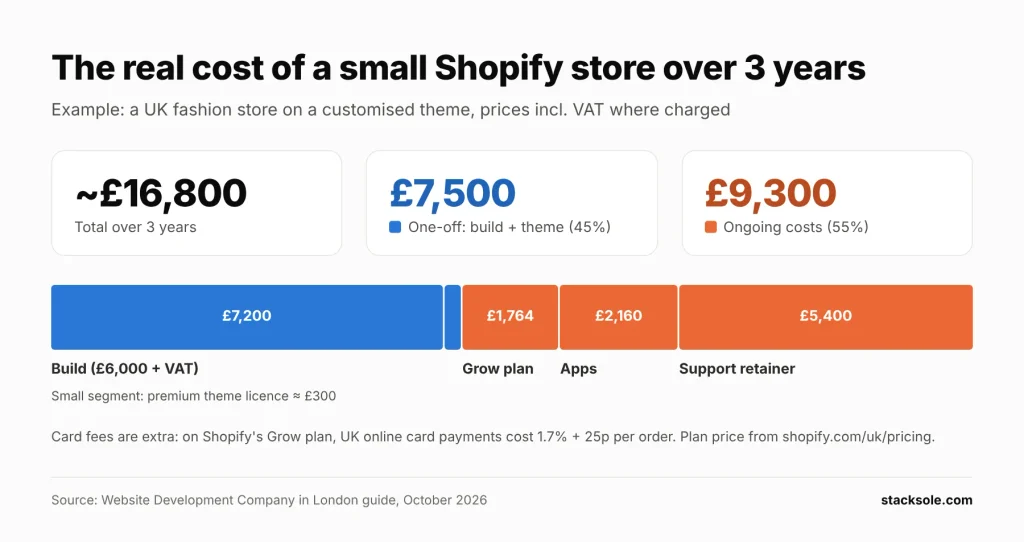
Example 1: small Shopify fashion store
| Cost | 3-year total |
|---|---|
| Build on a customised theme (£6,000 + VAT) | £7,200 |
| Premium theme licence | ~£300 |
| Shopify Grow plan (£49/month on yearly billing) | £1,764 |
| Apps: reviews, email, upsells (~£60/month) | ~£2,160 |
| Small support retainer (~£150/month) | ~£5,400 |
| Total | ~£16,800 |
That’s before card fees. On Shopify’s Grow plan in the UK, online card payments cost 1.7% + 25p. On £150,000 of yearly sales at a £45 average order, that’s roughly £3,400 a year.
Example 2: dental clinic on WordPress
| Cost | 3-year total |
|---|---|
| Build with online booking (£4,000 + VAT) | £4,800 |
| Managed hosting (~£25/month) | ~£900 |
| Domain and SSL | ~£45 |
| Plugin licences: booking, forms, backups (~£200/year) | ~£600 |
| Maintenance plan with updates and backups (~£75/month) | ~£2,700 |
| Total | ~£9,000 |
In both cases, ongoing costs roughly match or beat the build. Budget for them from day one.
Hidden costs to look for in a quote
- Content: Is copywriting included, or are you writing every page?
- Product uploads: Entering 300 products with variants can take days. Who does it?
- Data migration: Moving customers, orders and reviews from an old platform is often priced separately.
- Revisions: Two rounds are common. A third can be charged at the day rate.
- Payment and shipping setup: Stripe, PayPal, Klarna, Royal Mail or courier integrations.
- Post-launch fixes: CB and Webpop include 30 days. Others charge from day one.
Shopify vs WooCommerce vs WordPress vs custom: pick the platform first
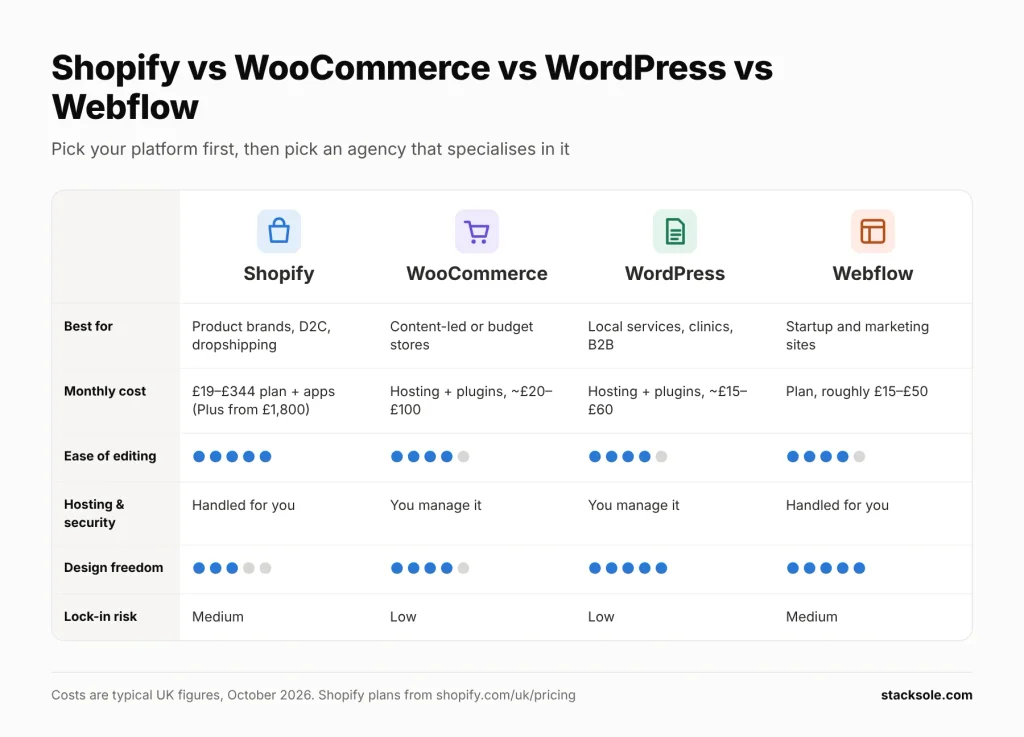
The platform decides more about your costs and flexibility than the agency does. Choose it before you shortlist, then find agencies that specialize in it.
| Shopify | WooCommerce | WordPress (no shop) | Webflow | Custom (React/Next.js, Laravel) | |
|---|---|---|---|---|---|
| Best for | Product brands, D2C, dropshipping | Content-led or budget stores | Local services, B2B, clinics | Marketing sites, startups | SaaS, marketplaces, complex apps |
| Monthly running cost | £19–£344 plan + apps (Plus from £1,800) | Hosting + plugins, ~£20–£100 | Hosting + plugins, ~£15–£60 | Plan-based, roughly £15–£50 for most sites | Hosting + developer time |
| Editing by your team | Very easy | Easy | Easy | Easy for marketers | Needs a developer or custom CMS |
| Hosting and security | Handled by Shopify | Your responsibility | Your responsibility | Handled by Webflow | Your responsibility |
| Lock-in risk | Medium | Low | Low | Medium | Depends on who owns the code |
How this plays out for real businesses:
- Dropshippers and Amazon sellers going D2C usually do best on Shopify. Apps for suppliers, reviews and marketplace sync are mature, and you don’t manage servers.
- A beauty brand publishing lots of tutorials and blog content may prefer WooCommerce, because WordPress handles content better and there’s no monthly platform fee.
- A restaurant taking online orders rarely needs a full shop. A WordPress site plus a commission-free ordering system often beats paying 30% to a delivery app.
- A dental clinic or estate agent needs fast pages, online booking and good local SEO. WordPress is the common, sensible choice.
- A SaaS founder typically uses Webflow or a headless setup for the marketing site and keeps the product app separate.
One red flag: an agency that recommends the same platform to every client. If every case study is on one platform, ask why it suits your business specifically.
What a good London web developer should handle for you
A website that looks good but can’t take payments, bookings or track ads is a brochure, not a business tool. Use these lists to check what’s actually in the quote.
For online stores
- Product pages with clear photos, sizing, delivery dates and reviews above the fold on mobile.
- A short checkout with Apple Pay, Google Pay, PayPal and Klarna. Every extra form field costs sales.
- UK shipping rules, VAT-inclusive pricing, and returns information that meets consumer law.
- Abandoned-cart emails connected to Klaviyo or Shopify Email.
- A product feed to Google Merchant Center, so your products can appear in Shopping ads and free listings.
- Marketplace sync if you also sell on Amazon or eBay, so stock doesn’t oversell.
For local and service businesses
- Online booking or ordering built in, not a link to a clunky third-party page.
- Click-to-call and map buttons that work on phones.
- LocalBusiness schema and a site structure that matches your Google Business Profile.
- A page per service and per area you cover, such as “Invisalign in Clapham”, not one long services page.
For SEO and Google Ads
- Fast load times, especially on mobile. Ask what Core Web Vitals scores they achieve on recent client sites.
- Clean URLs, headings and schema set up from day one.
- GA4, Google Search Console and Google Ads conversion tracking installed and tested before launch. Without this, your ad spend is guesswork.
- Landing pages you can duplicate for new campaigns without paying a developer each time.
After launch
- Software and plugin updates, daily backups and uptime monitoring.
- A clear response time for problems: is a broken checkout fixed in four hours or four days?
- Training, so your team can add products, posts and pages on its own. DCP, for example, includes this.
Redesign or rebuild? Fixing a site with low traffic or low sales
If your site isn’t bringing in traffic or sales, a full redesign is often the most expensive way to fix it. Find the cause first. These six checks take an afternoon and often point to a cheaper fix:
- Speed: Run your homepage and a product page through Google PageSpeed Insights on mobile. Scores under 50 usually come from oversized images, too many apps or a heavy theme.
- Tracking: Check GA4 is recording purchases or enquiries. Many “low sales” problems are really broken tracking, so you’re judging the site on bad data.
- Indexing: In Google Search Console, look at how many pages are indexed. If key pages are missing, traffic can’t arrive no matter how good the design is.
- Mobile checkout: Buy something on your own site with your phone. Count the taps and note anything annoying.
- Product and service pages: Thin descriptions, no reviews and no delivery information lose buyers who were ready to pay.
- Traffic sources: If traffic fell suddenly, check whether it lines up with a Google update or a site change.
When a fix beats a rebuild: if the problems are speed, tracking or a few weak pages, an SEO and CRO audit plus targeted fixes often costs £1,000–£3,000, far less than a £10,000 rebuild. Boost’s approach of auditing before quoting is a good sign in any agency.
When a rebuild makes sense: your platform can’t do what you need (subscriptions, multi-currency, B2B pricing), the theme is years out of date, or every small change needs a developer.
Don’t lose your Google rankings in a redesign
A badly handled relaunch is one of the most common reasons small businesses suddenly lose traffic. Insist on:
- A full redirect map from every old URL to its new equivalent, with 301 redirects.
- Keeping existing page titles, meta descriptions and content that already ranks, unless there’s a good reason to change them.
- Testing on a staging site before launch, then resubmitting the sitemap in Search Console.
- Weekly ranking and traffic checks for at least eight weeks after launch.
UK legal checklist for your new website
Your developer won’t give you legal advice, but a good one builds these in. If a quote doesn’t mention them, ask.
Cookies and tracking. The Data (Use and Access) Act 2025 changed PECR. Analytics cookies used only to improve your own site can now run without consent, as long as you explain them clearly and give visitors an easy way to opt out. Advertising cookies, including Meta Pixel and Google Ads tracking, still need consent before they fire. Maximum PECR fines have also risen to UK GDPR levels: up to £17.5 million or 4% of global turnover. If you sell to EU customers, keep asking consent for analytics too, because EU rules haven’t changed.
Privacy. You need a privacy policy that says what data you collect, why, and who you share it with (email platforms, payment providers, booking tools). Contact and booking forms should only ask for what you actually need.
Accessibility. Under the Equality Act 2010, businesses must make reasonable adjustments for disabled customers, and that includes your website. Aim for WCAG 2.2 AA: readable contrast, keyboard navigation, alt text on images and labelled form fields. It also tends to help SEO and conversions.
Online selling. The Consumer Contracts Regulations give shoppers a 14-day cancellation period for most online purchases. Your checkout and returns page should make this clear, and prices must show the total cost including VAT.
Healthcare and dental. Clinic websites must follow GDC and professional advertising rules: no misleading claims, clear practitioner registration details, and careful use of before-and-after photos. Choose a developer who has built for clinics before.
This is general information, not legal advice. For anything specific to your business, check the ICO website or speak to a solicitor.
10 questions to ask before you hire (and the red flags)
Ask every agency on your shortlist the same questions, then compare the answers side by side.
- Who owns the code, design files and domain when we finish? You should. CB Website Design, for example, transfers full ownership on final payment.
- Is development done in-house or outsourced? Either can work. What matters is that they tell you.
- Who will actually work on my project? Meet the developer or project lead, not just the salesperson.
- Can I see three live sites you built in the last 18 months? Then open them on your phone.
- What’s in the price, and what isn’t? Copy, product uploads, migration, revisions, training.
- How do you protect my SEO during launch? Listen for “redirect map” and “staging site”.
- What does support cost after launch, and how fast do you respond?
- Can I edit pages and products myself? Ask for a quick demo of the admin.
- How do you track conversions? GA4 and Google Ads tracking should be standard.
- What happens if we part ways? You need logins, files and a clean handover.
Red flags
- “Guaranteed #1 on Google.” No one can promise that.
- They host the site and won’t give you access. That’s lock-in, and it makes leaving expensive.
- A proprietary CMS only they can edit.
- No written scope or contract, just a total figure on an email.
- No live portfolio links, only screenshots or mockups.
- No company record. Search the business on Companies House. It takes 30 seconds and tells you how long they’ve been trading and whether their accounts are up to date.
- Pressure to pay 100% upfront. Milestone payments, like Webpop’s or CB’s, protect both sides.
Agency, freelancer or DIY: which is right for you?
Not everyone needs an agency. Here’s how the three options compare.
| London agency | Freelancer | DIY (Shopify, Wix, Squarespace) | |
|---|---|---|---|
| Typical cost | £3,000–£50,000+ | £800–£8,000 | £200–£1,000 in the first year |
| Speed | 4–16 weeks | 2–8 weeks | A weekend to a few weeks |
| Skills covered | Strategy, design, build, SEO, support | Usually one or two strong skills | Only what you learn |
| Risk | Low if vetted | Higher if they disappear | Low cost, but your time is the cost |
| Best for | Growing businesses with real revenue riding on the site | Clear, smaller projects | Testing an idea, very first site |
If you don’t have a website yet, a DIY Shopify or Squarespace site is a fine way to start selling or get found. Once it’s making money, an agency can rebuild it properly.
If you’re a freelancer taking on bigger clients, many London agencies offer white-label development. You keep the client relationship and they handle the heavy build work.
If revenue depends on the site, such as an e-commerce brand doing £5,000+ a month, the extra cost of an agency usually pays for itself through fewer outages and better conversion.
Frequently asked questions
How much does a website cost in London?
A small business site usually costs £1,500–£6,000 plus VAT. A proper e-commerce store runs £5,000–£30,000 plus VAT, and custom web apps start around £25,000. Running costs for hosting, apps and support often add £1,000–£4,000 a year.
How long does it take to build a website?
Three to six weeks for a simple WordPress site, eight to twelve weeks for a bespoke business site or store, and three months or more for a custom app. Delays usually come from content, so have your text and photos ready.
Is it cheaper to hire a web developer outside London?
Yes. Regional UK agencies often charge 20–40% less, and offshore teams less again. You trade off in-person meetings and, with offshore teams, some time-zone friction. For standard Shopify or WordPress builds, location matters less than portfolio and process.
Do I own my website after an agency builds it?
You should, but check the contract. Make sure you own the domain, the code, the design files and the hosting account, or at least have admin access to all of them.
Shopify or WooCommerce for a small online store?
Shopify if you want the least technical hassle and plan to grow through ads and social. WooCommerce if you publish a lot of content, want lower monthly fees, and are happy to manage hosting and updates.
Can a web development company also do SEO and Google Ads?
Many can. Stacksole offers SEO and Google Ads alongside its builds, and Charle, DCP and CB Website Design all offer SEO too. At minimum, any developer should set up technical SEO and conversion tracking, even if a specialist runs your campaigns.
How do I know if my website needs a redesign?
If it’s slow on mobile, hard for you to update, can’t do something your business needs, or looks clearly older than your competitors, it’s time. If traffic or sales have dropped, run the six checks in the redesign section first.
What should a website maintenance plan include?
Software and plugin updates, daily backups, security monitoring, uptime alerts, a set number of small changes each month, and a guaranteed response time for urgent problems.
Do London agencies work with startups on small budgets?
Some do. Ask about phased launches: start with a lean version of the site, then add features once you have revenue or funding. Studios that offer retainers, like Shoreditch Design, are often more flexible.
Final thoughts
The best website development company in London is the one that fits your platform, budget and stage of business, not the one with the biggest client logos. A Shopify beauty brand, a dental clinic in Ealing and a seed-stage SaaS founder need three different partners.
A simple way to decide:
- Pick your platform first.
- Shortlist three agencies from the quick picks that specialise in it.
- Send all three the same written brief on the same day.
- Ask the ten questions above and compare the answers side by side.
Do that, and you’ll know within a fortnight which team you trust with your business.
If you’d like Stacksole to be one of your three quotes, you can request a free quote on our website.

Need help with your website?
Stacksole provides web development, ecommerce development, WordPress development, SEO and digital marketing services for businesses in the UK and worldwide.