WooCommerce Development Companies in London: 7 Verified Agencies for 2026
Search for a WooCommerce agency in London, and you’ll run into two problems fast. First, half the “London” agencies on the top lists are actually in Stafford, Staffordshire or Bournemouth. Second, the prices make…
SBy StacksoleWeb Development & Digital Marketing
Search for a WooCommerce agency in London, and you’ll run into two problems fast. First, half the “London” agencies on the top lists are actually in Stafford, Staffordshire or Bournemouth. Second, the prices make no sense: one guide says a basic WooCommerce store starts at £3,500, another says £18,000. Both can’t be your budget.
This guide fixes both. We looked at more than 30 agencies from the top-ranking lists and directories and kept only the ones with a real London address and WooCommerce listed as a core service. Seven made the cut. For each one, we tell you how much actual WooCommerce work it shows, quote its prices where they’re published, and say so when they aren’t.
Full disclosure: this guide is published by Stacksole, a London-registered agency that builds and runs WooCommerce stores. We’ve listed ourselves first and held our profile to exactly the same template as everyone else’s, weaknesses included. Judge us the same way you judge the others.
TL;DR
Want one team for any type of WooCommerce store, plus SEO and Google Ads? Stacksole (our agency).
Tight budget? DCP Web Designers publishes WooCommerce stores from £1,995 + VAT.
Want a bespoke store at a fixed price? Webpop Design, with bespoke WooCommerce rebuilds from £10,000.
Store with integrations, subscriptions or a migration? Fhoke or Lilo, both with named WooCommerce client stores.
Typical London budget: £2,000–£12,000 for a small-to-mid WooCommerce store, £15,000+ for custom or B2B, plus 20% VAT.
Last verified: October 2026. No other agency paid to be included.
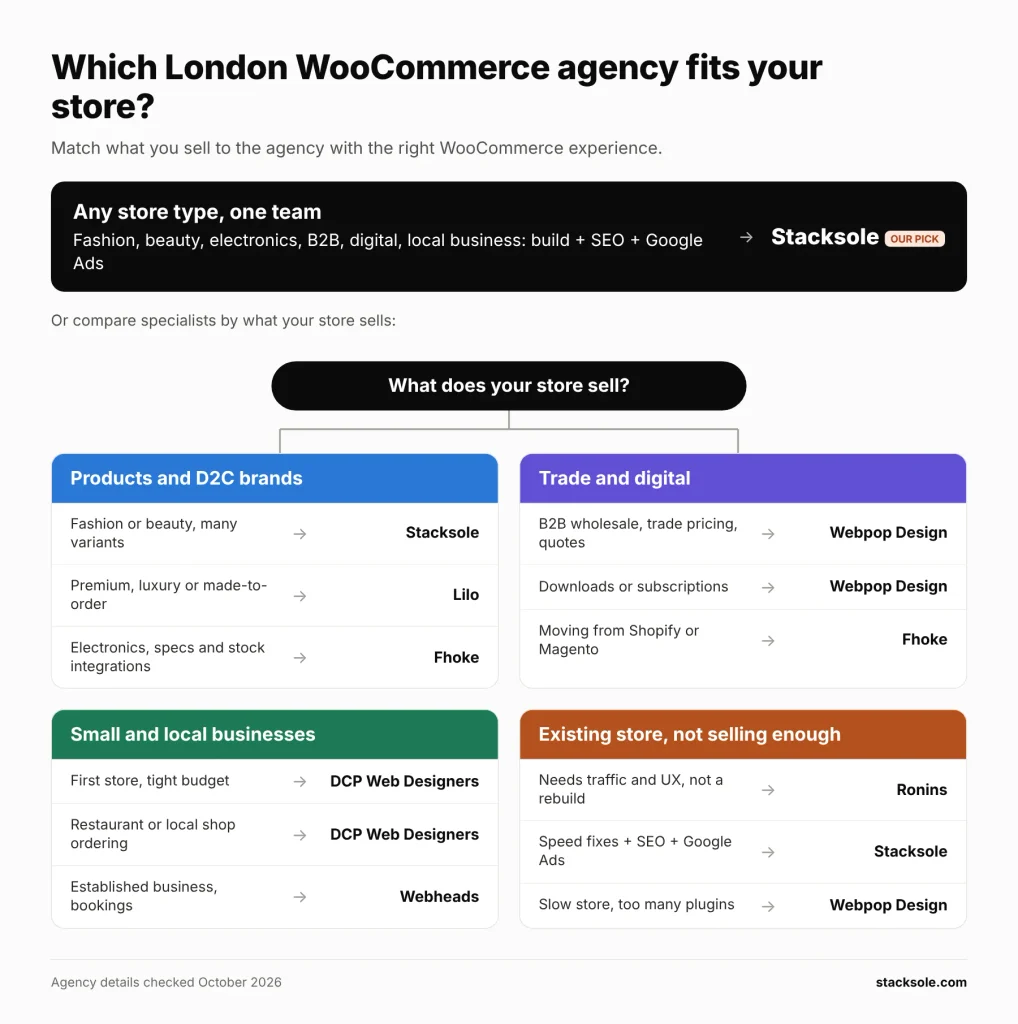
Quick picks: the best WooCommerce development company in London for your store
Pick the row that sounds like your store. Full profiles follow further down.
Your store
Start with
Why
Published price
Any type of store (fashion, beauty, electronics, B2B, digital, local business) that wants build, SEO and Google Ads from one team
Stacksole
All-in-one: builds every kind of WooCommerce store, plus Shopify, WordPress and custom sites, and runs SEO and Google Ads; UK company with in-house developers in Mumbai
Free quote
First online shop, local business or tight budget
DCP Web Designers
Fixed WooCommerce packages, 3–6 week turnaround, 400+ Google reviews
From £1,995 + VAT
B2B wholesale, trade pricing or distributor portal
Webpop Design
Built a B2B WooCommerce store with distributor portal and online quoting for Cygnus Instruments
Rebuilds from £10,000
Digital downloads or subscriptions
Webpop Design
Black Sheep Press store handles downloads and subscription resources
Rebuilds from £10,000
Moving from Shopify, Magento or BigCommerce
Fhoke
Lists migrations from all three; WooCommerce work for more than a decade
On request
Premium or luxury product store
Lilo
WooCommerce builds for Bellerby & Co Globemakers and Tag Fine Arts
£5,000–£100,000
Travel, bookings or established business wanting a long-standing agency
Webheads
30+ years in web design, Soho Square office, ecommerce for Golden Tours
On request
Store whose main problem is traffic and growth, not the build
Ronins
Growth agency covering SEO, paid media and UX alongside WooCommerce
On request
How we chose (and checked) these agencies
We started with every agency named in the top-ranking London WooCommerce articles, plus London results on directories like Sortlist. That’s more than 30 names. Then we applied three rules.
1. A real London address. Not a phone number, not “serving London”. This cut a lot. Plenty of agencies that show up when you search for WooCommerce developers in London are based elsewhere: Kanuka Digital (Stafford), Harrison Carloss (Staffordshire) and Envisage Digital (Bournemouth) all appear on other “London” lists. So do Plug and Play Design, whose only listed office is in Guildford, and Altar, which is registered in Scotland. Each may be a perfectly good WooCommerce development agency in the UK, just not a London one. One directory’s London page even featured an agency based in Nepal.
2. WooCommerce as a core service. Wholegrain Digital is a well-known London WordPress agency, but its site doesn’t mention WooCommerce or show any stores, so it’s out. 93digital, listed by both competitors, now redirects to a different brand, so we couldn’t verify it.
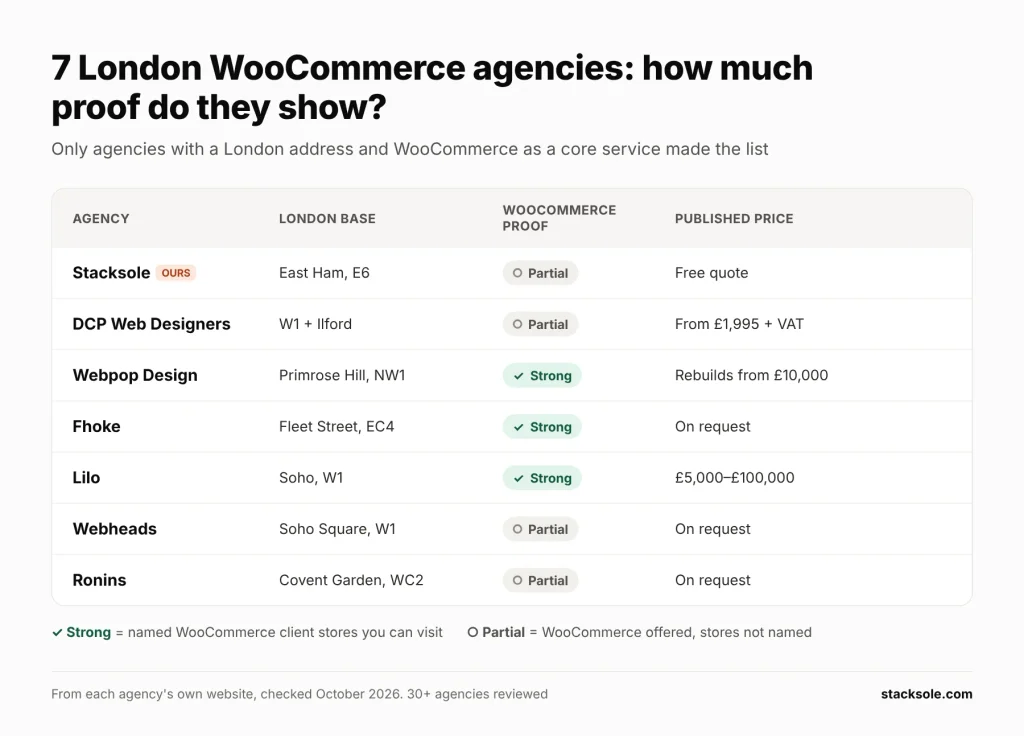
3. Evidence you can check. For each agency we graded how much WooCommerce work it actually shows:
Strong: named WooCommerce client stores you can visit.
Partial: WooCommerce is offered as a service, but the stores built aren’t named.
We also noted published prices, timelines and review counts, because a page full of logos tells you much less than one honest price.
Editor’s note before publishing: run each named client store through BuiltWith or Wappalyzer to confirm it runs WooCommerce, and add one mobile PageSpeed Insights score per agency with the test date. No competing list does this, and it’s the strongest proof in the article.
7 London WooCommerce agencies at a glance
Agency
London base
WooCommerce evidence
Best for
Published price
Timeline
Stacksole (our agency)
East Ham, E6 (registered office) + Mumbai dev centre
Partial (add case study before publishing)
All store types: build + SEO + ads in one team
Free quote
From 5–6 days (standard site)
DCP Web Designers
W1 + Ilford, IG1
Partial
Small shops, tight budgets
From £1,995 + VAT
3–6 weeks
Webpop Design
Primrose Hill, NW1
Strong: Cygnus Instruments, Black Sheep Press, UK Home Interiors, Cultivator
B2B, subscriptions, bespoke stores
Rebuilds from £10,000
10–12 weeks
Fhoke
Fleet Street, EC4 (+ Salisbury)
Strong: The Pop-Up Hotel, Paris Tile, Xpert Workwear, Fumo
Migrations, integrations
On request
Scoped per project
Lilo
Wardour Street, Soho, W1
Strong: Bellerby & Co Globemakers, Tag Fine Arts
Premium and luxury products
£5,000–£100,000
On request
Webheads
Soho Square, W1
Partial
Established businesses, bookings
On request
On request
Ronins
Covent Garden, WC2 (+ Guildford)
Partial
Growth-focused stores
On request
On request
All details come from each agency’s own website, checked October 2026.
The 7 best WooCommerce development companies in London (2026)
1. Stacksole — best all-in-one partner for any type of store
Stacksole
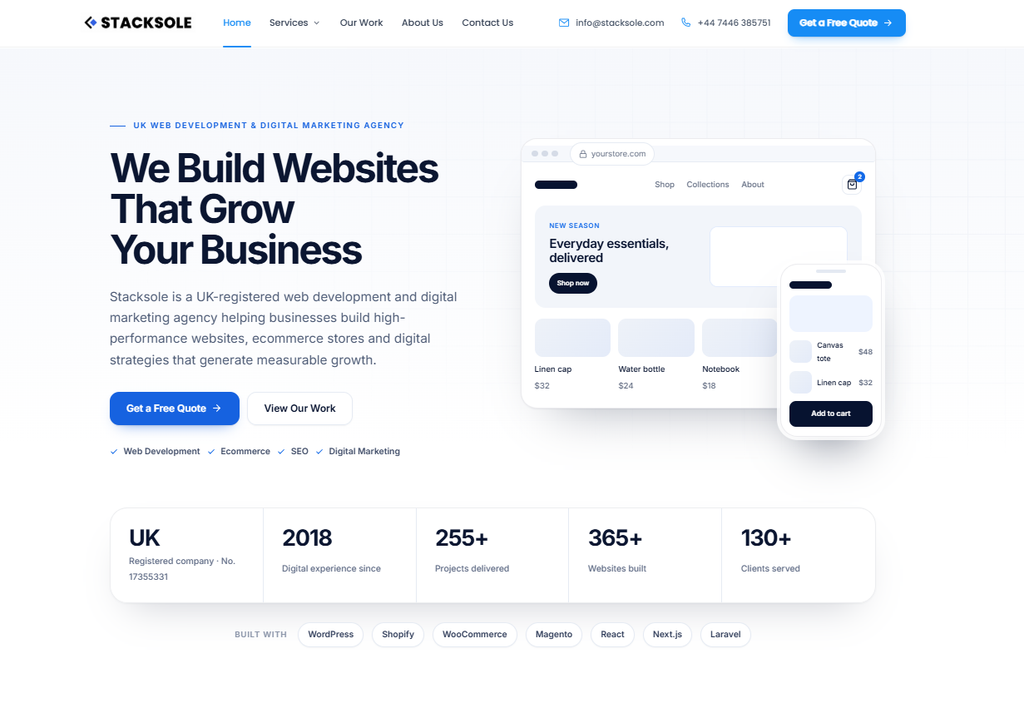
Stacksole is the trading name of NEPTISE LTD (company no. 17355331), with a registered office in East Ham, London E6, and a development centre in Mumbai. You contract with a UK company, and an in-house team in India builds the store. That’s how the pricing stays well below typical London day rates.
On the WooCommerce side, the team handles custom themes, WooCommerce, WordPress, Shopify and Magento builds, plus React and Laravel for custom work. The same team also runs SEO, Google Ads and social media, so whoever builds your product pages also sets up the tracking and campaigns that send people to them. It isn’t tied to one niche: Stacksole’s portfolio covers beauty and cosmetics, fashion, jewellery and pet care stores, it builds industry sites for healthcare, real estate, education and legal firms, and it reports 255+ projects for 130+ clients.
Editor’s note: add one named WooCommerce store Stacksole built, with a link and a real result (speed before/after, conversion or sales change). Without it, this profile shows less WooCommerce evidence than Webpop, Fhoke or Lilo.
Choose them if you want one team to build any kind of WooCommerce store, from a fashion brand or electronics shop to a B2B catalogue or a clinic’s online shop, and then grow it with SEO and Google Ads at a price a growing business can manage.
Think twice if you want regular face-to-face workshops in a London studio. Most development and meetings are remote, and prices aren’t published, so ask for a quote.
2. DCP Web Designers — best for first stores and tight budgets
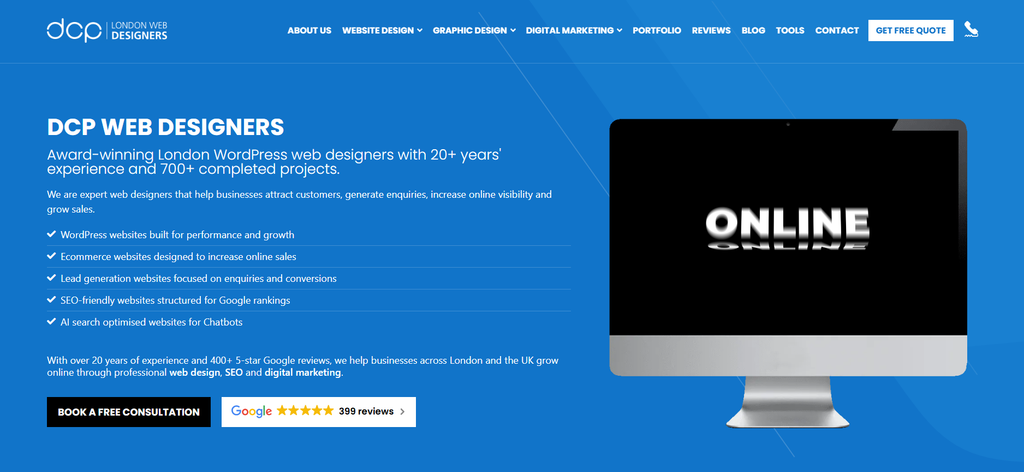
DCP is the only agency on this list that publishes a WooCommerce price on its homepage: stores start from £1,995 + VAT, with most projects launching in three to six weeks. It has offices in W1 and Ilford and has been running since 2004.
The review numbers are the strongest here: 400+ Google reviews averaging 4.9, plus a 5.0 rating from 40 reviews on Clutch. Builds use WordPress, WooCommerce and Elementor Pro, with Cloudflare and NitroPack for speed, and clients are trained to manage products themselves. SEO support is available monthly.
Choose them if you’re a small business, local shop or new brand that needs a working, editable store without a five-figure bill.
Think twice if you need custom checkout logic, B2B pricing or ERP integrations. Page-builder sites are quick to edit but harder to make fast once a catalogue grows.
3. Webpop Design — best for B2B, subscriptions and bespoke stores
Webpop, based in Primrose Hill, has the clearest WooCommerce portfolio of anyone here. It built a B2B store for Cygnus Instruments with a distributor portal and automated online quoting, a digital downloads and subscription platform for Black Sheep Press, and stores for UK Home Interiors and the Ayurvedic brand Cultivator.
Its WooCommerce B2B wholesale work covers trade pricing, bulk ordering, ERP and accounting integrations, migrations with SEO redirects, and performance clean-ups. It also offers custom WooCommerce plugin development for features off-the-shelf plugins can’t handle. Smaller improvement projects start from a few thousand pounds; bespoke rebuilds start from £10,000. Builds take 10–12 weeks and launch from a private test site with a rollback plan.
Choose them if you sell to trade customers, sell subscriptions or downloads, or need a store built around how your business actually works.
Think twice if you need to launch in a month.
4. Fhoke — best for migrations and integrations
Fhoke has a London studio on Fleet Street and a second in Salisbury. It’s worked with WordPress since 2008 and WooCommerce for more than a decade, and it’s also a Shopify partner, which is useful if you’re weighing up both platforms.
Named WooCommerce stores include The Pop-Up Hotel, Paris Tile, Fumo and the Belfast workwear brand Xpert Workwear. Fhoke lists migrations to WooCommerce from Shopify, BigCommerce and Magento, plus integrations with subscriptions, CRM, ERP, stock and fulfilment systems.
Choose them if you’re moving platforms or connecting your store to stock, accounting or fulfilment systems.
Think twice if you want a price up front. Everything is scoped per project.
5. Lilo — best for premium and luxury product stores
Lilo works from Wardour Street in Soho, with further offices in Cape Town and Perth. Its WooCommerce clients include Bellerby & Co Globemakers, which makes handmade globes, and the gallery Tag Fine Arts. Both are high-value products where presentation drives the sale.
Services include bespoke store design, payment gateway setup (Stripe, PayPal, Apple Pay), subscriptions and dynamic pricing, migrations and SEO. Lilo’s FAQ puts typical projects between £5,000 and £100,000.
Choose them if you sell premium, made-to-order or high-ticket products online.
Think twice if you want detailed results before signing. The site shows no case-study metrics.
6. Webheads — best for established businesses and booking-led stores
Webheads, at Soho Square, has more than 30 years in web design and a long logo list including the BBC, NHS and Planet Hollywood. It offers WooCommerce development alongside SEO, AI search visibility and PPC. Its featured ecommerce project is Golden Tours, a travel and tourism site.
It doesn’t name which of its clients run WooCommerce, so ask to see live WooCommerce stores before you shortlist.
Choose them if you want a long-established London agency that can also handle search and paid ads.
Think twice if you need proof of WooCommerce-specific work. It’s offered, but not shown.
7. Ronins — best for stores that need growth more than a rebuild
Ronins is a growth agency with offices in Covent Garden and Guildford, covering SEO, paid media, UX audits and development, including WooCommerce. Its published results are about growth: Catch, an angling platform, tripled visitors and sign-ups in 12 months, and National Extension College doubled organic traffic.
Choose them if your store works but isn’t selling enough, and you want UX and marketing fixed before anyone talks about a rebuild.
Think twice if you need a WooCommerce build specialist. None of the case studies shown are WooCommerce stores.
WooCommerce vs Shopify in the UK: when WooCommerce is actually the right call
WooCommerce isn’t automatically the better choice, and an agency that says it always is should worry you. Here’s the honest trade-off.
WooCommerce
Shopify
Monthly platform fee
None (WooCommerce itself is free)
£19–£344 a month; Plus from £1,800
Hosting
You choose and pay for it
Included
Extra features
Plugins: many free, premium ones often renew yearly
Apps: usually monthly fees
Third-party payment fees
None from WooCommerce
0.6–2% extra if you don’t use Shopify Payments (not on Plus)
Content and SEO
Full WordPress: blogs, guides, landing pages
Good, but blogging and page building are more limited
Custom rules (B2B pricing, odd products)
Very flexible
Possible, but often needs apps or Plus
Maintenance
You (or your agency) handle updates and security
Shopify handles it
Ownership
You own the code and data
You rent the platform
WooCommerce is usually the better fit if:
You’re content-led. A beauty brand publishing skincare guides and tutorials gets more from WordPress than from Shopify’s blog.
Your pricing is unusual. Trade price lists, quote requests, customer-specific discounts and minimum order values are where WooCommerce shines.
You sell digital products, like downloads, courses or software licences, and want full control over delivery.
You already run a WordPress site and want the shop in the same place.
Shopify is usually the better fit if:
You don’t want to think about servers, updates or security. Ever.
You’re an Amazon seller or dropshipper moving to your own store and want supplier and marketplace apps working on day one.
You sell mostly through Instagram and TikTok and want those channels to just work.
How much does WooCommerce development cost in London?
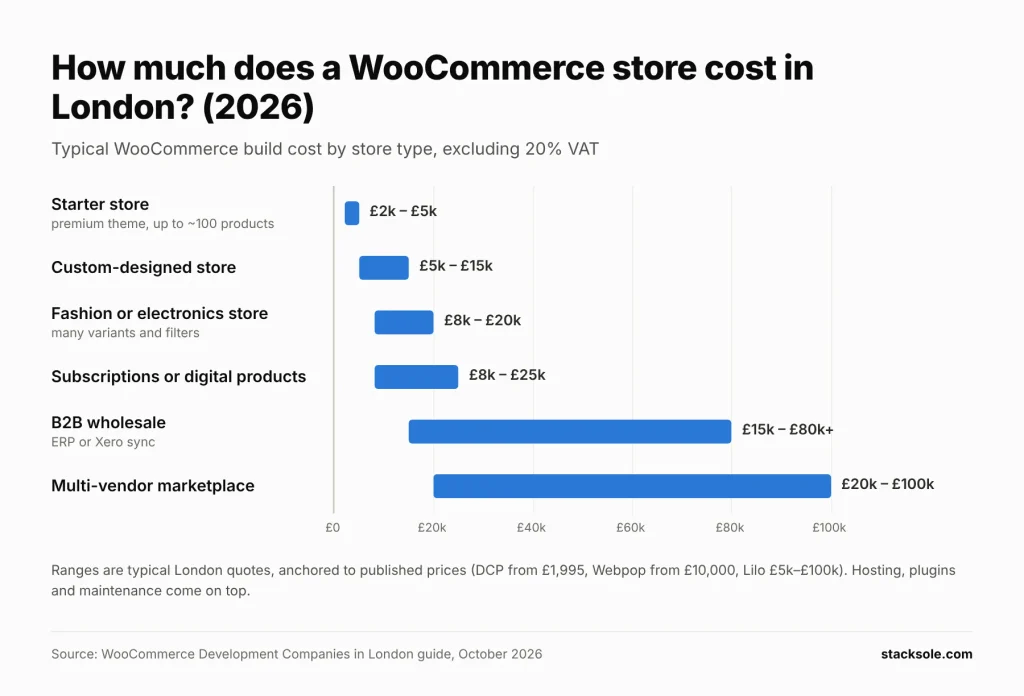
Most small-to-mid WooCommerce stores built in London cost £2,000–£12,000, and custom or B2B builds start around £15,000. Agencies with turnover above £90,000 must add 20% VAT, so most established agencies will. Small freelancers may not. Outside London, WooCommerce development cost in the UK is typically 20–40% lower, because regional agencies have lower overheads.
Why do the top-ranking guides disagree so much (one says stores start at £3,500, another at £18,000)? Because they’re describing different stores. Here’s what the price actually buys:
Type of WooCommerce store
Typical London price (ex. VAT)
Incl. 20% VAT
What you get
Starter store on a premium theme
£2,000–£5,000
£2,400–£6,000
Up to ~100 products, standard checkout, payments and shipping set up
Custom-designed store
£5,000–£15,000
£6,000–£18,000
Bespoke design, filters, improved checkout, integrations with email and analytics
Variant-heavy fashion or electronics store
£8,000–£20,000
£9,600–£24,000
Sizes and colours, swatches, size guides, spec filters, fast search
Subscription or digital products store
£8,000–£25,000
£9,600–£30,000
Recurring billing, downloads or licence delivery, customer accounts
B2B wholesale with ERP or Xero sync
£15,000–£80,000+
£18,000–£96,000+
Trade pricing, quote requests, account terms, stock and accounting sync
Multi-vendor marketplace
£20,000–£100,000
£24,000–£120,000
Vendor accounts, commissions, payouts
These ranges line up with the prices agencies publish: DCP’s stores start from £1,995 + VAT, Webpop’s bespoke rebuilds from £10,000, and Lilo quotes £5,000–£100,000 depending on complexity.
The 3-year cost of a WooCommerce store
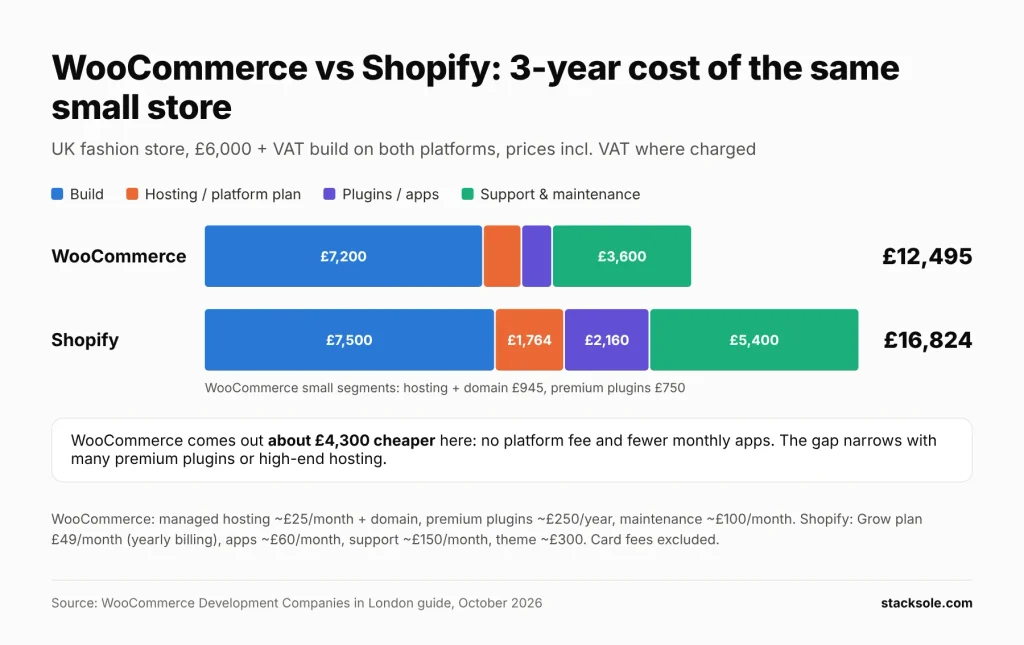
WooCommerce has no monthly platform fee, but that doesn’t make it free to run. Here’s a realistic example for a small fashion store.
Card fees come on top. Stripe and PayPal charge per transaction, but WooCommerce itself takes nothing.
A warning about hosting: entry-level WooCommerce hosting is often advertised at around £2 a month, but that’s an introductory price. SiteGround’s UK WooCommerce plans, for example, renew at £13.99–£34.99 a month, plus VAT. Budget for the renewal price, not the headline.
Same store on Shopify, for comparison
The same store on Shopify’s Grow plan (£49/month on yearly billing) with about £60/month of apps and a smaller £150/month support retainer comes to roughly £16,800 over three years, including a £6,000 + VAT build. WooCommerce comes out cheaper here mainly because there’s no platform fee and fewer monthly apps. The gap closes if you need lots of premium plugins or expensive managed hosting.
Hidden costs in WooCommerce quotes
Plugin licences: premium plugins usually renew yearly. WooCommerce Subscriptions, for example, costs $279 a year. Ask whose name the licences are in.
Product import: entering 500 products with variants can take days.
Data migration: moving customers, orders and reviews is often quoted separately.
Payment and courier setup: Stripe, PayPal, Klarna, Royal Mail and DPD integrations.
Extra revision rounds: two is common; more are charged at the day rate.
What a good WooCommerce developer should handle: the technical checklist
This is the section that separates a WooCommerce specialist from a general web agency that “also does shops”. You don’t need to understand the code, but you should ask about every item here.
HPOS (High-Performance Order Storage)
WooCommerce used to store orders in the same database tables as blog posts, which slowed busy stores down. HPOS moves orders into dedicated tables, and it has been switched on by default for new stores since WooCommerce 8.2 in October 2023.
Ask: “Are your builds HPOS-compatible, and have you migrated an older store to HPOS?” If you run a store set up before late 2023, it may still use the old storage, and some older plugins aren’t compatible. A good developer checks every plugin before switching.
Plugin discipline
Most slow WooCommerce stores have the same problem: too many plugins doing overlapping jobs, like two caching plugins, three page-builder add-ons or a heavy slider nobody uses.
Ask: “How many plugins will this build use, and why each one?” Also ask for premium licences to be bought in your name, so you keep updates and support if you change agency.
Hosting
Hosting type
Typical UK cost
Good for
Shared WooCommerce hosting
~£14–£35/month at renewal
New stores with modest traffic
Managed WooCommerce hosting
~£25–£100+/month
Growing stores; updates, backups and caching handled
VPS or cloud server
~£30–£200+/month plus setup
Large catalogues and high traffic, with a developer managing it
Cheap hosting doesn’t just slow pages down. It’s usually the checkout that suffers most, because cart and checkout pages can’t be cached the way product pages can.
Speed optimisation
Google’s Core Web Vitals targets are a good shared benchmark: the main content loads within 2.5 seconds (LCP), the page responds to taps within 200 milliseconds (INP), and the layout doesn’t jump around (CLS under 0.1). Ask what scores the agency’s recent WooCommerce stores achieve on mobile, then test one yourself in PageSpeed Insights.
Staging and updates
WooCommerce and its plugins update often. Updating straight on a live store is how checkouts break on a Friday night. A proper agency tests every update on a staging copy first, then pushes it live. Webpop, for example, describes launching from a private test site with a rollback plan. When you compare WooCommerce maintenance services in the UK, check that staging-first updates are included, not charged extra.
Security
Two-factor login for every admin account.
Daily off-site backups you can restore yourself.
A web application firewall and malware scanning.
Fraud screening, especially for digital products and high-value items, where card testing and chargebacks are common.
UK setup your WooCommerce store needs
A store built for the US market will feel slightly wrong to UK shoppers and may break UK rules. Check your agency’s quote covers all of this.
Payments. Stripe, PayPal, Apple Pay and Google Pay cover most UK shoppers. Klarna or another pay-later option often lifts average order value for fashion and beauty. More gateways isn’t better, though. A fast, short checkout matters more than offering eight ways to pay.
Shipping. Live rates and labels for Royal Mail, DPD or Evri, tracking emails, and free-shipping thresholds. Local businesses should add click-and-collect.
VAT and pricing. UK shoppers expect prices to include VAT. Your developer should set up tax classes properly, including zero-rated items like children’s clothing, and handle EU orders if you ship abroad.
Accounting. Syncing orders to Xero, QuickBooks or Sage saves hours of manual entry every month.
Legal.
Cookies: the Data (Use and Access) Act 2025 lets you run analytics cookies without consent, as long as you explain them and offer an easy opt-out. Advertising cookies, like the Meta Pixel and Google Ads tags, still need consent. The ICO’s cookie guidance sets out the rules.
Returns: online shoppers can usually cancel within 14 days of receiving their order and get a refund, including standard delivery.
Privacy: a clear privacy policy that names the services you share data with, such as email, payment and shipping providers.
Accessibility: aim for WCAG 2.2 AA so disabled customers can actually buy from you.
Marketing tracking. GA4 ecommerce events, Google Ads conversion tracking and a Google Merchant Center product feed should all be tested before launch. Without them, any SEO or Google Ads spend is guesswork.
Which agency fits your store type?
Business size matters less than what you sell. Each store type needs different WooCommerce features, so here’s what to ask for and who to shortlist. Stacksole (our agency) builds every store type below; the other names are the specialists worth comparing against.
Store type
What it needs in WooCommerce
Shortlist
Fashion and clothing
Variations with colour swatches, size guides, fast filters, easy returns
Stacksole, Lilo, DCP (smaller ranges)
Beauty and cosmetics
Bundles, subscribe-and-save, reviews with photos, ingredient and tutorial content
Online ordering, collection slots, simple menus you can edit
DCP, Stacksole
Dental, health and beauty clinics
Product sales plus bookings, careful compliance with advertising rules
DCP, Webheads
Underperforming existing store
Audit first: speed, tracking, checkout, then targeted fixes
Ronins, Stacksole
If you’re a freelancer taking on a WooCommerce project bigger than you can handle alone, ask agencies about white-label development. You keep the client; they handle the heavy build.
Migrating to (or from) WooCommerce without losing sales or rankings
A badly handled platform move is one of the fastest ways to lose Google traffic you spent years building. The move itself is rarely the problem. Skipped steps are. Google’s own site move guide is worth reading before you start.
What moves across, and what doesn’t
Data
Usually transfers?
Notes
Products, variants, images
Yes
Check variant options and image order after import
Categories and collections
Yes, with mapping
Shopify collections and WooCommerce categories work differently
Customers
Yes
Passwords don’t transfer; customers reset them on first login
Order history
Yes
Important for repeat customers and accounting
Reviews
Usually
Depends on the review app or plugin
Apps and plugins
No
Each one needs a WooCommerce equivalent or a rebuild
URLs
No
Must be redirected (see below)
The SEO-safe migration checklist
Export every URL on the old store, including products, categories, pages and blog posts.
Map each old URL to its new WooCommerce URL and set up 301 redirects. Shopify’s /products/ and /collections/ paths won’t exist on WooCommerce, so this step is essential.
Keep page titles, meta descriptions and product copy that already rank.
Build and test everything on a staging site, including test orders with real payment methods.
Launch at a quiet time, submit the new sitemap in Google Search Console, and test redirects immediately.
Watch rankings, traffic and sales weekly for at least eight weeks. Some fluctuation is normal; a steady drop isn’t.
For a Shopify to WooCommerce migration, Fhoke, Webpop and Lilo all list migrations as a service. Ask any agency to show you a redirect map from a previous project.
When leaving WooCommerce makes sense
If you’re spending more on maintenance and fixes than on growing the store, have no technical help, and sell simple products mainly through social media, Shopify can be the calmer choice. The same checklist applies in reverse.
10 questions to ask a WooCommerce agency (and the red flags)
Before you hire a WooCommerce developer in London, send every agency on your shortlist the same questions and compare the answers side by side. A genuine WooCommerce expert will answer all ten without hesitating.
Can I see three live WooCommerce stores you built in the last two years? Then check they really run WooCommerce. Free tools like BuiltWith or Wappalyzer show it in seconds.
Are your builds HPOS-compatible? Ask if they’ve migrated an older store, too.
How many plugins will my store use, and whose name are the licences in?
Who hosts the store, and will I have full access?
How do you test updates before they go live? Listen for “staging”.
What’s in your care plan, and how fast do you fix a broken checkout?
Who owns the code, theme and design files when we finish?
Will you set up GA4, Google Ads conversions and a Merchant Center feed?
Is development done in-house or outsourced? Either can work. What matters is that they tell you.
What happens if we part ways? You need every login, file and licence handed over.
Red flags
A “WooCommerce” portfolio full of Shopify stores. Check it.
40+ plugins on a simple store. It’ll be slow and fragile.
They host it and won’t give you access. That makes leaving expensive.
No staging site. Updates will be tested on your live customers.
“Guaranteed #1 on Google.” Nobody can promise that.
No Companies House record, or a “London” agency with no London address. Search the company name on Companies House; it takes 30 seconds.
Pressure to pay 100% upfront. Milestone payments protect both sides.
Frequently asked questions
How much does WooCommerce development cost in London?
A starter store usually costs £2,000–£5,000 plus VAT, a custom-designed store £5,000–£15,000, and B2B or subscription stores from around £15,000. Running costs for hosting, plugins and maintenance typically add £1,500–£3,000 a year.
How long does it take to build a WooCommerce store?
Three to six weeks for a store on a premium theme, 10–12 weeks for a bespoke build, and three months or more for B2B stores with integrations. Product data is usually what causes delays, so get it ready early.
Is WooCommerce cheaper than Shopify?
Often, yes. WooCommerce charges no monthly platform fee or extra transaction fees. But you pay for hosting, premium plugins and maintenance. For a small store over three years, WooCommerce typically comes out a few thousand pounds cheaper. With many premium plugins or high-end hosting, the gap narrows.
Is WooCommerce secure?
Yes, when it’s maintained. Most WooCommerce security problems come from outdated plugins, weak admin passwords and cheap hosting. Regular updates, two-factor login, a firewall and daily backups solve most of the risk.
How many products can WooCommerce handle?
Tens of thousands, with the right hosting and setup. HPOS, a good search plugin and proper caching matter more than the product count itself.
Do I need managed WooCommerce hosting?
Not on day one. Once you’re taking regular orders, managed hosting usually pays for itself through faster checkout, automatic backups and fewer emergencies.
Can a WooCommerce agency also do SEO and Google Ads?
Many can. Stacksole, Webheads and Ronins all offer SEO and paid search alongside development, and DCP offers monthly SEO support. At minimum, any developer should set up technical SEO and conversion tracking before launch.
Can you fix or speed up my existing WooCommerce store?
Usually, yes, and it’s often cheaper than a rebuild. Start with a WooCommerce speed optimisation audit covering plugins, images and hosting. Removing unused plugins, fixing images and moving to better hosting can transform a slow store.
Is WooCommerce good for B2B wholesale?
It’s one of WooCommerce’s strengths. Trade price tiers, quote requests, account terms and ERP sync are all achievable. Webpop’s distributor portal for Cygnus Instruments is a good London example.
Should I hire a WooCommerce freelancer or an agency?
A freelancer is fine for a simple store and small fixes. If your store is your main source of revenue, an agency gives you backup cover, testing and support when something breaks at the worst moment.
Final thoughts
The right WooCommerce partner depends far more on what you sell than on how big the agency is. A fashion brand with 2,000 variants, a B2B parts supplier and a restaurant taking collection orders need very different builds.
A simple way to decide:
Find your store type in the quick picks.
Shortlist three agencies that suit it.
Send all three the same brief on the same day.
Ask the ten questions above, and check their WooCommerce stores yourself.
Do that, and within a fortnight you’ll know who you trust with your store.
If you’d like a second opinion on an existing store first, Stacksole offers a free WooCommerce store audit covering speed, plugins and HPOS readiness.
Stacksole is a leading web development company with over 7 years of experience. They offer various services, including custom web development, e-commerce development, and digital marketing. stacksole is known for their high-quality work, competitive prices, and excellent customer service.
Need help with your website?
Stacksole provides web development, ecommerce development, WordPress development, SEO and digital marketing services for businesses in the UK and worldwide.